Guide · Cap tables
How SAFEs convert and dilute founders
Pre-money and post-money SAFEs, valuation caps, discounts and the option pool shuffle, explained with one worked example in which an 80% headline becomes 54.4% for the founders.
What is a SAFE?
A SAFE (simple agreement for future equity) is a contract in which an investor pays money now in exchange for shares issued later, usually at the company’s next priced equity round. It was popularised by Y Combinator and is widely used for pre-seed and seed funding, including well beyond the US.
A standard SAFE is not a loan. It carries no interest and no maturity date, which is what separates it from a convertible note. Instead it sets the terms on which it will convert: most often a valuation cap, sometimes a discount, and sometimes both. Until it converts, the holder owns no shares, which is exactly why SAFEs are easy to forget when founders describe their ownership.
That is the problem this guide is about. Each SAFE looks small on the day it is signed. Several of them, plus an option pool and a priced round, can move founder ownership a long way from what the round’s headline valuation suggests.
What is the difference between pre-money and post-money SAFEs?
The difference is who bears the dilution from other SAFEs. The original SAFE measured the cap against the company’s pre-money capitalisation. Y Combinator’s post-money SAFE, introduced in 2018 and now widely used, measures it against the capitalisation including all SAFEs.
| Feature | Pre-money SAFE | Post-money SAFE |
|---|---|---|
| Cap measured against | Capitalisation before SAFEs convert | Capitalisation including all converting SAFEs |
| Holder's ownership | Not known until the round, because it depends on other SAFEs | Known at signing: amount ÷ post-money cap |
| Dilution from later SAFEs | Shared by founders and earlier SAFE holders | Falls on founders and other existing shareholders |
| Diluted by the priced round | Yes | Yes, by the new money and by a pool increase made in the round |
| Easy for founders to model | Harder | Easier, but easy to underestimate when SAFEs stack |
For a post-money SAFE the arithmetic is simple, and worth memorising:
SAFE ownership before the round = amount invested ÷ post-money valuation cap
So a $0.5M SAFE with a $5M post-money cap is 10% of the company, measured just before the priced round. A second SAFE of $0.8M at an $8M cap is another 10%. Together they take 20% before a single new share is sold.
How do valuation caps and discounts work?
A valuation cap is the maximum valuation at which a SAFE converts, protecting the early investor if the priced round comes in high. A discount is a percentage reduction on the price new investors pay, rewarding the early investor for coming in first.
- Cap price = valuation cap ÷ the relevant share count (for a post-money SAFE, the company capitalisation including all SAFEs but excluding the new pool increase).
- Discount price = round price per share × (1 − discount). With a 20% discount and a $1.00 round price, the discount price is $0.80.
- If a SAFE has both, it converts at whichever price is lower, so the holder receives more shares. The two are never combined.
- If the cap price is above the round price, the cap does not help the holder, and a cap-only SAFE converts at the round price.
Watch for a most-favoured-nation (MFN) clause, which lets a holder adopt better terms given to a later SAFE, and for side letters granting pro rata rights. Both change the cap table and both are checked in due diligence.
What is the option pool shuffle?
The option pool shuffle is when the new or enlarged employee option pool is counted inside the pre-money valuation, so its cost falls on existing shareholders rather than on the incoming investor. Investors commonly ask for a pool sized as a percentage of the post-money company, created before their money goes in.
The effect is a lower effective pre-money valuation. If a round is priced at $12M pre-money and $15M post-money, and the term sheet asks for a 12% post-money pool created in the pre-money, the pool is worth 12% × $15M = $1.8M. Existing shareholders are really being valued at $12M − $1.8M = $10.2M.
Effective pre-money = headline pre-money − (pool % × post-money)
That $10.2M matters twice: it is what founders and SAFE holders share, and it is the ceiling below which a SAFE cap has to sit for the cap to apply.
Worked example: how 80% becomes 54.4%
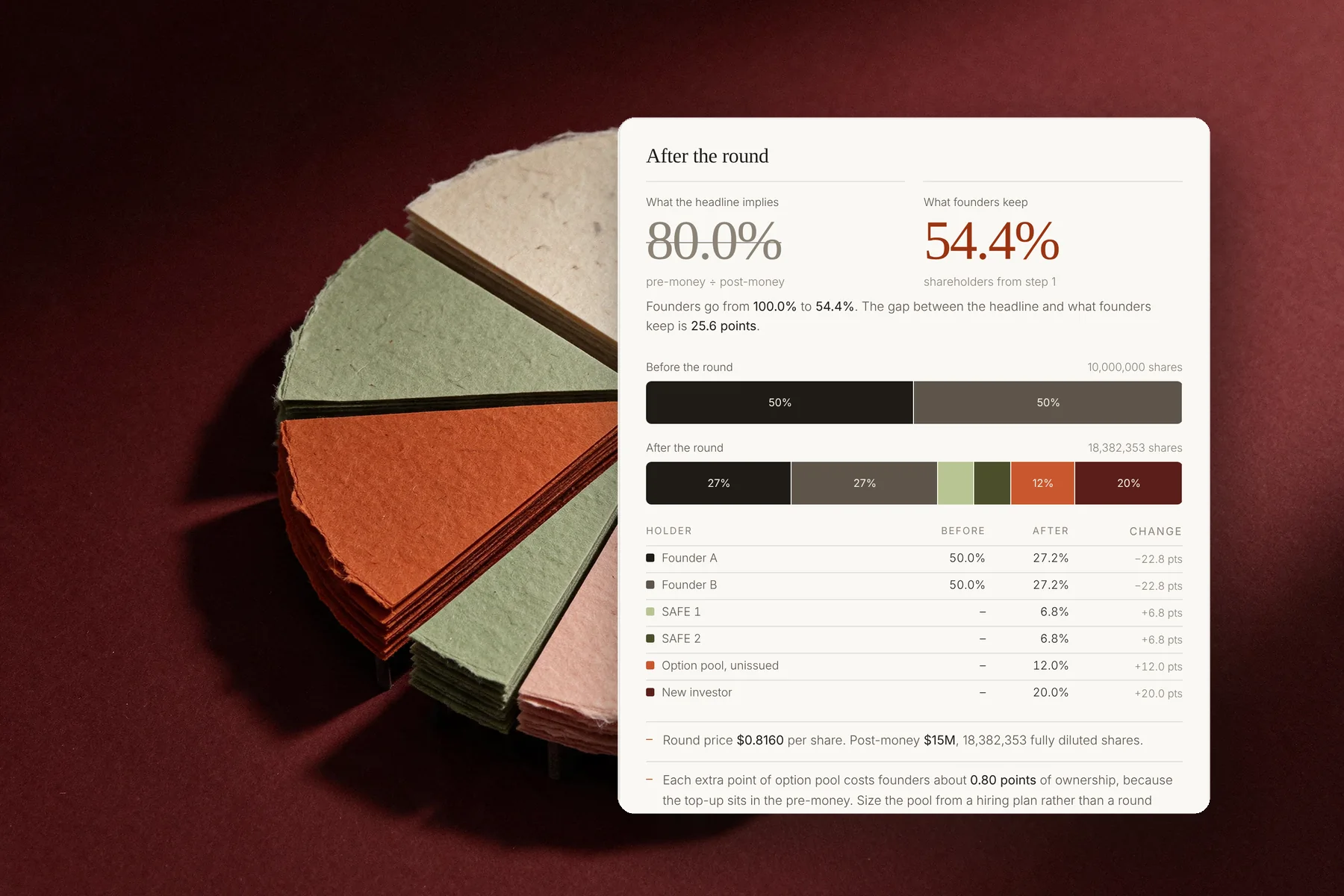
These are the same inputs as the dilution model on our home page and the defaults in the cap table modeller. Two founders own 5,000,000 shares each, with no existing option pool. They have raised two post-money SAFEs and are now closing a priced seed round.
| Input | Value |
|---|---|
| Pre-money valuation | $12M |
| New money raised | $3M |
| Post-money valuation | $15M |
| Option pool (post-money, created in the pre-money) | 12% |
| SAFE 1 | $0.5M at a $5M post-money cap |
| SAFE 2 | $0.8M at an $8M post-money cap |
| Founder shares before the round | 10,000,000 |
Step by step
- The headline: 80%Pre-money ÷ post-money = $12M ÷ $15M = 80%. This is what founders often assume they keep, because it is what they would keep with no SAFEs and no pool.
- The new investor: 20%$3M ÷ $15M post-money = 20% of the company after the round.
- The pool: 12%Set by the term sheet as 12% of the post-money company, created before the new money goes in.
- What is left for founders and SAFEs: 68%100% − 20% − 12% = 68%. This is the effective $10.2M pre-money from the option pool shuffle.
- The SAFEs take 20% of that 68%SAFE 1 is $0.5M ÷ $5M = 10% and SAFE 2 is $0.8M ÷ $8M = 10%, so 20% of what is left: 13.6% of the company, or 6.8% each.
- Founders keep 54.4%68% × (1 − 20%) = 54.4%. A gap of 25.6 percentage points from the 80% headline.
Pre-money ÷ post-money
After SAFEs, the pool and the new money
The cap table after the round
| Holder | Shares | Ownership | Price per share |
|---|---|---|---|
| Founder A | 5,000,000 | 27.2% | – |
| Founder B | 5,000,000 | 27.2% | – |
| SAFE 1 ($0.5M at $5M cap) | 1,250,000 | 6.8% | $0.40 |
| SAFE 2 ($0.8M at $8M cap) | 1,250,000 | 6.8% | $0.64 |
| Option pool, unissued | 2,205,882 | 12.0% | – |
| New investor ($3M) | 3,676,471 | 20.0% | $0.8160 |
| Total | 18,382,353 | 100.0% |
Three checks confirm the numbers hang together:
- SAFE prices. Before the round there are 10,000,000 founder shares and 2,500,000 SAFE shares, so 12,500,000 shares. SAFE 1 converts at $5M ÷ 12.5M = $0.40 and SAFE 2 at $8M ÷ 12.5M = $0.64.
- Round price. The $12M pre-money buys the 14,705,882 shares that exist before the new money (founders, SAFEs and pool), so the price is $12M ÷ 14,705,882 ≈ $0.8160. The investor’s $3M buys 3,676,471 shares.
- The caps apply. Both SAFE prices are below the $0.8160 round price, equivalent to both caps being below the $10.2M effective pre-money. Had either cap been above it, that SAFE would have converted at the round price instead.
What moves founder ownership the most?
Change one input at a time from the worked example and founder ownership moves like this. Every case keeps both SAFE caps below the effective pre-money, so the caps still apply.
| Change from the example | Founders keep | vs 54.4% |
|---|---|---|
| No SAFEs outstanding | 68.0% | +13.6 pts |
| No option pool in the round | 64.0% | +9.6 pts |
| Pool of 8% instead of 12% | 57.6% | +3.2 pts |
| SAFE 2 cap of $10M instead of $8M | 55.8% | +1.4 pts |
| Pool of 15% instead of 12% | 52.0% | −2.4 pts |
| Raise $4M instead of $3M at the same pre-money | 50.4% | −4.0 pts |
Two lessons follow. First, each point of option pool costs founders about 0.8 points here, because founders hold 80% of what is left after the SAFEs take their 20%. Size the pool from a written hiring plan, not a round number. Second, the SAFEs already signed matter more than the cap on the next one: they were priced when the company was worth less.
How can founders limit SAFE dilution?
- Model before you sign. Add every new SAFE to a pro forma cap table on the day you agree terms, not when the priced round arrives.
- Track the stack. Keep one register of every SAFE, note and side letter with amount, cap, discount, MFN and pro rata rights, matched to the signed copy.
- Size the pool from a hiring plan. Show the investor which roles the pool will cover over the next 18 to 24 months and how many options each needs.
- Negotiate the pool, not just the valuation. A smaller pool, or one partly created after the round, can be worth more to founders than a higher headline pre-money.
- Get advice on the documents. SAFE templates vary, and local law affects how they work outside the US. Your lawyer should review every instrument before signing.
Last reviewed November 2026. General information, not legal, tax or investment advice. Check your own situation with a licensed adviser.
FAQ
Questions founders ask
When does a SAFE convert into shares?
A SAFE usually converts at the next priced equity round, when the company sells shares at a set price per share. It can also pay out or convert on a sale of the company or an IPO, and return money in a dissolution, depending on its terms. Until then the holder owns no shares and has no vote.
Is a post-money SAFE worse for founders than a pre-money SAFE?
Not worse, but more predictable for the investor. With a post-money SAFE the holder's percentage is fixed when it is signed, so every later SAFE dilutes the founders rather than earlier SAFE holders. That makes the founder's own dilution easier to calculate, and easier to underestimate if several SAFEs are stacked.
How do I calculate a post-money SAFE's ownership?
Divide the amount invested by the post-money valuation cap. A $0.5M SAFE with a $5M post-money cap converts into 10% of the company measured just before the priced round, and the new investor and any pool increase then dilute that 10%. In the worked example it ends at 6.8%.
What is the option pool shuffle?
It is when the new option pool, or a top-up of it, is counted inside the pre-money valuation. The pool's cost then falls entirely on existing shareholders rather than on the new investor, so the effective pre-money valuation is lower than the headline. In our example a 12% pool turns a $12M pre-money into an effective $10.2M.
Do a SAFE's cap and discount both apply?
If the SAFE has both, the holder normally gets whichever gives the lower conversion price, and therefore more shares. They are not added together. A SAFE with only a cap converts at the cap price if that is below the round price, and otherwise at the round price.
How much dilution is normal in a seed round?
There is no single normal figure: it depends on the raise, the valuation, the pool and the SAFEs converting. The useful habit is to model it before you sign anything. Faction42's free cap table modeller shows founder ownership after SAFEs, the pool and the new money, with every formula visible.